Arrived in Cuenca early this morning. It was a short flight, no more than 40 minutes or so, but the early wakeup time of 5 in the morning did bode well for me. Been having trouble staying asleep through the entire night... probably thinking about home too much.
Although I´ve never been to Spain, those who have visited there have repeatedly remarked that Cuenca does not feel Ecuadorian at all, rather, it is much more Spanish. Architecture, language, dress, and skin color all hint towards a more Euorpean background than many of the surrounding cities. Cuenca is also devoutly Catholic, claims an indigenous population of 0%, and is probably the most conservative city in the country. The streets are clean, tourist friendly, and the shopping, at least in the area of the hotel, is nothing less than first rate.
Since I´m so tired I don´t have too much to say. Perhaps tomorrow will be better...
Highlight of tomorrow for me will probably be the Panama Hat factory. I would really like to purchase one for my classroom... I´m not entirely convinved I can pull off the look. I will have to consult with Farris who is our resident fashion expert.
Tuesday, July 29, 2008

Monday, July 28, 2008
New Pics Posted on Picasa
A few pictures from the Amazon portion of the trip have been uploaded. Feel free to leave comments.
Rainforest on the Napo River
Returned last afternoon from 7 days at the Yachana Ecolodge and Technical School. The lodge is accessed easiest by motorized canoe, going upstream from Coca and taking about 2 1/2 hours depending on the height of the Napo River. Arriving in Coca, also known as Puerto Francisco de Orellana, the change in the weather was apparent and quickly confirmed by damp clothes about 5 steps off the plane. The humidity could be oppressive, especially during the early afternoon hours when it was better to take a short nap then brave the beating sun and humidity. A short trip through Coca to a hotel where we saw the only monkey, though quite tame, for the entire Amazon trip. We boarded the Yachana canoe and started upriver; we were served a box lunch to help pass the time.
When we first arrived at the lodge, we found our accommodations far exceeding our expectations: flush toilets, drinkable water, sporadic electricity, wireless internet, hot showers, 3 gourmet meals a day, and new sheets and towels every other day... the amenities were indicative of the less than truly authentic experience that we would have. We settled into our rooms, then met in the newly constructed dining area that overlooks the Napo river. This is where we met Juan, our guide for the duration of our stay, who we would come to appreciate, respect, and marvel at as we got to know his history, personal experiences, and world view.
Juan hails from the Shiwiar indigenous ethnic group, which owns approximately 180,000 acres of land about 3-5 days of river canoe travel from the border of Peru. His people, which are hunter-gatherers, have been in the same spot for about the last 20-30 years, with numbers hovering around 970 community members. Recounting the many stories of Juan's life in the accuracy, length, and detail they deserve would result in quite an engaging book-length writing project, but here is a short rundown to give you an idea about the kind of man we're dealing with here:
The general schedule for an average day at the lodge consisted of breakfast at 7:00, a morning walk with Juan as a guide, a leisurely lunch followed by a 1 - 2 1/2 hour siesta (which helped to beat the heat), another walk to a site where we would participate in a craft, or watch a demonstration, followed by some time to relax before dinner which was promptly served at 7:00 in the evening. For the first few nights we were the only folks at the lodge which afforded us a lot of attention from both the staff and Douglas McMeekin, the former outright owner and now executive director of the Yachana Lodge and Technical School. Douglas, born in Lexington, Kentucky, struggled through school and university, made a mint in real estate in the '80s before promptly going bankrupt, and somehow ended up in Ecuador. Douglas's only sibling, a brother, also happens to live in South America, in Chile I believe, and is retired from the World Bank.
Our interactions with Douglas forced many in the group to take a step back and critically think about what was truly occurring economically, socially, and ecologically near the small community of Mondana on the Napo River. Douglas, an unabashedly self-professed business man, claims to have combined ecotourism, education, rain forest preservation, self-sustainability, and community development into a model that turns a profit for the promotion and continued existence of the lodge and school, with the added benefit of preserving and rehabilitating former cattle pastures, poorly managed farms, secondary forests, and primary forest. To date, 4300 acres of "rain forest" have been preserved and protected, usually through the purchase of tracts of land no bigger than 125 acres at a time, bought from individuals who received the land through grants offered by the government to help settle and cultivate the land in distances extending from 6 kilometers on each side of the river. Each kilometer is known as "a line." Because of this snatching of land by "colonios" which includes mestizos and Kichwa populatoins alike, the Guarani indigenous group has been pushed away from the river and deep into the forest.
Originally, the land was offered by the government because it was believed that it would be valuable for farming and cattle grazing, but as many people slowly came to realize, the delicate eco-balance and relationships that allow the amazing flora and fauna to flourish is ruined when Western concepts and ideas of farming and agriculture are introduced to the region. According to Juan, only the top 8cm or so of soil in the rain forest is able to support plant growth. The soil beneath this rich layer of constant decomposition is quite acidic and poor for farming and is easily lost once exposed to the constant erosion brought forth by heavy rains. Evidence of this delicate balance was obvious walking through the forests, where many tree roots are exposed and very near the surface of the ground. Many trees and plants made up for the lack of vertical root penetration by extending great distances just below the surface horizontally. The powerful affects of erosion were also immediately evident. As it continued to rain upstream the river rose overnight as much as 6 feet, taking plants and plucking entire trees from the side of the river bank as the soil that held them in place was quickly removed. This amazing process was accompanied by resounding crashes and booms that rivaled thunder as entire trees crashed into the river. Another visitor, a geographer from Eastern Illinois University, remarked that it was similar to watching chunks of icebergs crashing into the ocean.
Upon reflecting on our experience at the lodge, the majority of the group came to the conclusion that this was not an authentic Amazonian experience as the lodge and the surrounding area had already been too far impacted by the presence of humans. In essence, the land was ¨sterile.¨None of the megafauna that we badly wanted to see was present. Granted, 15 gringos tromping through the forest is enough to scare any animal with a sense of preservation to the hills, but regardless, it was obvious that this area lacked the biodiversity that existed in deeper areas of the Amazon. This conclusion was confirmed by our group leader, Diane, who has had much richer experiences within Ecuador at other lodges and outposts. Upon furhter reflection, debate, and much discussion, the issue was raised as to Douglas´s motivation behind the preservation of this specific portion of forest. Was this the best use of the foundation´s funds? Are there not areas with a more pressing need for preservation that is truly considered untouched primary forest? Is this just where he ended up? What criteria was used to select this land for preservation and were indigenous experts and locals consulted?
Despite the work of the foundation, two roads have been built on both sides of the river, and electricity is expected to be present within the next 6 to 12 months. The presence of convenient, cheap electrical power will permamently alter the landscape surrounding the Yachana Lodge, the Yachana Preserve, and the community of Mondaña. Light and noise pollution, not to mention the increased presence of settlers will further expedite the changes brought forth by modernization. The ability of the environment to keep up with the change was overcome by the pressing needs and demands of the increasing populations and settlements.
coming soon... notes on the school.
When we first arrived at the lodge, we found our accommodations far exceeding our expectations: flush toilets, drinkable water, sporadic electricity, wireless internet, hot showers, 3 gourmet meals a day, and new sheets and towels every other day... the amenities were indicative of the less than truly authentic experience that we would have. We settled into our rooms, then met in the newly constructed dining area that overlooks the Napo river. This is where we met Juan, our guide for the duration of our stay, who we would come to appreciate, respect, and marvel at as we got to know his history, personal experiences, and world view.
Juan hails from the Shiwiar indigenous ethnic group, which owns approximately 180,000 acres of land about 3-5 days of river canoe travel from the border of Peru. His people, which are hunter-gatherers, have been in the same spot for about the last 20-30 years, with numbers hovering around 970 community members. Recounting the many stories of Juan's life in the accuracy, length, and detail they deserve would result in quite an engaging book-length writing project, but here is a short rundown to give you an idea about the kind of man we're dealing with here:
- At only 2 weeks old, survived an attack by a shaman which required his parents to travel 4 days through the jungle to seek help from the most powerful healing shaman that could be found. Through traditional practices, the healing shaman was able to identify the illness, bite the center of Juan's chest, and remove a large beetle that had been living inside him and making him sick. Testament to this story is evident in the very large scar in the center of his chest and the respect and appreciation that Juan carries for the powers of a trained Shaman to do both bad and good.
- As a young boy, Juan survived Malaria twice, once being remedied by traditional medicines, and another time with Western medical practices that required Juan to walk 3 days through the jungle to the nearest military base in order to receive treatment.
- Survived "jungle rot" or "jungle leprosy" with the help of Western medicine; it had been eating the flesh of his face, and required a sequence of shots for 30 days, twice a day.
- Has 5 brothers and 2 sisters. Four siblings did not survive.
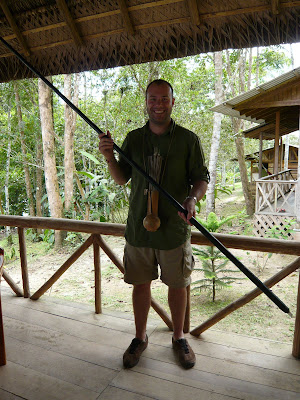
- Could live on his own in the jungle from the age of 12 for 3-5 days with nothing more than a blowgun... need I say more? This, it is important to note, is also Juan's favorite hobby or activity; hunting in the jungle, living off the land, and being one with nature.
- Trained to become a shaman for two years with hopes of exacting revenge for the attack when he was only 2 weeks old. After much debate and talking with his sibling, parents, and grandparents, this goal of revenge was abandoned, but Juan would still like to complete his shaman training. In a story that will be recounted at a later time, Juan's shaman training would come to save him from further attacks from a jealous shaman living near the Yachana lodge. To make a long story short, Juan let this person know if attacks continued, he would not be long for the world and would end up as a shrunken head.
- Actually opted to bite the head off a piranha instead of using a machete. This proved to be a drastic miscalculation, with the piranha getting the best of Juan´s face... much to his dismay, with a scar to prove it.
The general schedule for an average day at the lodge consisted of breakfast at 7:00, a morning walk with Juan as a guide, a leisurely lunch followed by a 1 - 2 1/2 hour siesta (which helped to beat the heat), another walk to a site where we would participate in a craft, or watch a demonstration, followed by some time to relax before dinner which was promptly served at 7:00 in the evening. For the first few nights we were the only folks at the lodge which afforded us a lot of attention from both the staff and Douglas McMeekin, the former outright owner and now executive director of the Yachana Lodge and Technical School. Douglas, born in Lexington, Kentucky, struggled through school and university, made a mint in real estate in the '80s before promptly going bankrupt, and somehow ended up in Ecuador. Douglas's only sibling, a brother, also happens to live in South America, in Chile I believe, and is retired from the World Bank.
Our interactions with Douglas forced many in the group to take a step back and critically think about what was truly occurring economically, socially, and ecologically near the small community of Mondana on the Napo River. Douglas, an unabashedly self-professed business man, claims to have combined ecotourism, education, rain forest preservation, self-sustainability, and community development into a model that turns a profit for the promotion and continued existence of the lodge and school, with the added benefit of preserving and rehabilitating former cattle pastures, poorly managed farms, secondary forests, and primary forest. To date, 4300 acres of "rain forest" have been preserved and protected, usually through the purchase of tracts of land no bigger than 125 acres at a time, bought from individuals who received the land through grants offered by the government to help settle and cultivate the land in distances extending from 6 kilometers on each side of the river. Each kilometer is known as "a line." Because of this snatching of land by "colonios" which includes mestizos and Kichwa populatoins alike, the Guarani indigenous group has been pushed away from the river and deep into the forest.
Originally, the land was offered by the government because it was believed that it would be valuable for farming and cattle grazing, but as many people slowly came to realize, the delicate eco-balance and relationships that allow the amazing flora and fauna to flourish is ruined when Western concepts and ideas of farming and agriculture are introduced to the region. According to Juan, only the top 8cm or so of soil in the rain forest is able to support plant growth. The soil beneath this rich layer of constant decomposition is quite acidic and poor for farming and is easily lost once exposed to the constant erosion brought forth by heavy rains. Evidence of this delicate balance was obvious walking through the forests, where many tree roots are exposed and very near the surface of the ground. Many trees and plants made up for the lack of vertical root penetration by extending great distances just below the surface horizontally. The powerful affects of erosion were also immediately evident. As it continued to rain upstream the river rose overnight as much as 6 feet, taking plants and plucking entire trees from the side of the river bank as the soil that held them in place was quickly removed. This amazing process was accompanied by resounding crashes and booms that rivaled thunder as entire trees crashed into the river. Another visitor, a geographer from Eastern Illinois University, remarked that it was similar to watching chunks of icebergs crashing into the ocean.
Upon reflecting on our experience at the lodge, the majority of the group came to the conclusion that this was not an authentic Amazonian experience as the lodge and the surrounding area had already been too far impacted by the presence of humans. In essence, the land was ¨sterile.¨None of the megafauna that we badly wanted to see was present. Granted, 15 gringos tromping through the forest is enough to scare any animal with a sense of preservation to the hills, but regardless, it was obvious that this area lacked the biodiversity that existed in deeper areas of the Amazon. This conclusion was confirmed by our group leader, Diane, who has had much richer experiences within Ecuador at other lodges and outposts. Upon furhter reflection, debate, and much discussion, the issue was raised as to Douglas´s motivation behind the preservation of this specific portion of forest. Was this the best use of the foundation´s funds? Are there not areas with a more pressing need for preservation that is truly considered untouched primary forest? Is this just where he ended up? What criteria was used to select this land for preservation and were indigenous experts and locals consulted?
Despite the work of the foundation, two roads have been built on both sides of the river, and electricity is expected to be present within the next 6 to 12 months. The presence of convenient, cheap electrical power will permamently alter the landscape surrounding the Yachana Lodge, the Yachana Preserve, and the community of Mondaña. Light and noise pollution, not to mention the increased presence of settlers will further expedite the changes brought forth by modernization. The ability of the environment to keep up with the change was overcome by the pressing needs and demands of the increasing populations and settlements.
coming soon... notes on the school.
Saturday, July 19, 2008
Education and Filet Mignon
Today was a relaxed day. Slept in a bit, a leisurely breakfast, visited the market, and got a first class haircut for six bucks. Took an hour to pack for the Amazon, watched some Tour de France with Spanish commentators, and had a short nap.
At 5:00 we met with a bilingual educator who is in on some cutting edge reforms in the Ecuadorian education system. A very interesting presentation, with some thoughtful questions from the group. It looks like bilingual education here is moving in a direction that is very different from that of the United States. The new system is driven by individual mastery of concepts and units, allowing each child to advance or receive remediation at his or her own pace. Students are not limited to a specific timetable and teachers take on the role of facilitator, concentrating mostly on the most needy students. Like any system, they are negatives. There seems to be less support for very high achieving students and those on the opposite end of the spectrum. The units (or workbooks) must usually be purchased by the student and can cost as much as 15 dollars, which is a significant sum of money here. This is compounded by the cost of uniforms and access to school supplies that many students in the United States take for granted.
The country also faces a shortage of dedicated and passionate teachers. Like anywhere, there will always be people who teach because the privilege of working with young learners is unlike any other privilege one could experience as a job, but teaching here is often viewed as a last resort when no other jobs could be found. Starting salaries usually start around 250$ a month, which is payed by the government. Rural areas, with limited road access and amenities, are especially difficult to populate with teachers. The government has promised to deliver as many 12,000 new teachers in the next few years, but in reality, upwards of 30,000 teachers or more are needed to adequately staff the education system.
After dinner, we invited our guest speaker and his family to stay with us at the hotel and eat dinner with us. All 20 of us went to an Argentinian restaurant; it was phenomenal. Although the wine was overpriced, it was difficult to complain about a pound of expertly prepared, buttery smooth filet mignon with mashed potatoes and asparagus for with 8.50! It was a wonderfully warm atmosphere with great food, friends, and conversation.
Tomorrow entails an early morning and breakfast, followed by a bus, plain, and motorized canoe ride into the Amazon.
At 5:00 we met with a bilingual educator who is in on some cutting edge reforms in the Ecuadorian education system. A very interesting presentation, with some thoughtful questions from the group. It looks like bilingual education here is moving in a direction that is very different from that of the United States. The new system is driven by individual mastery of concepts and units, allowing each child to advance or receive remediation at his or her own pace. Students are not limited to a specific timetable and teachers take on the role of facilitator, concentrating mostly on the most needy students. Like any system, they are negatives. There seems to be less support for very high achieving students and those on the opposite end of the spectrum. The units (or workbooks) must usually be purchased by the student and can cost as much as 15 dollars, which is a significant sum of money here. This is compounded by the cost of uniforms and access to school supplies that many students in the United States take for granted.
The country also faces a shortage of dedicated and passionate teachers. Like anywhere, there will always be people who teach because the privilege of working with young learners is unlike any other privilege one could experience as a job, but teaching here is often viewed as a last resort when no other jobs could be found. Starting salaries usually start around 250$ a month, which is payed by the government. Rural areas, with limited road access and amenities, are especially difficult to populate with teachers. The government has promised to deliver as many 12,000 new teachers in the next few years, but in reality, upwards of 30,000 teachers or more are needed to adequately staff the education system.
After dinner, we invited our guest speaker and his family to stay with us at the hotel and eat dinner with us. All 20 of us went to an Argentinian restaurant; it was phenomenal. Although the wine was overpriced, it was difficult to complain about a pound of expertly prepared, buttery smooth filet mignon with mashed potatoes and asparagus for with 8.50! It was a wonderfully warm atmosphere with great food, friends, and conversation.
Tomorrow entails an early morning and breakfast, followed by a bus, plain, and motorized canoe ride into the Amazon.
Friday, July 18, 2008
Mascarilla
Yesterday we visited a 100% Afro-Ecuadorian comunity. The village´s name was Mascarilla, but maps and signs do not recognize this name, instead offering more derogatory names denoting the skin color of the inabitants. We arrived at about 8:00 in the morning. This was by far the hottest and most arid we had visited since being in Ecuador. It is located at the bottom of the Mira watershed, and looks drastically different than El Angel and the water reserve at the top of the watershed from the day before.
After disebarking from the bus, we met Paquita and Julia. Paquita and Julia were founding members of GAEN, an oganization from within the community with mostly women members, who coordinate programs for the economic development of the community and host programs for the children of the village in the summer. Since I was the leader of the day, I had to introduce myself and the group in Spanish. It could have been worse, but did not come off as well as I would have liked. After group introductions, Julia left to continue making the snacks for the children (basically beans and salsa) and our lunch, which was boiled beef with vegetables. Paquita brought us to the summer program for children, this is where the miscommunication and cultual differences took its toll.
We quickly introduced ourselves to the camp, as the children waited impatienty in lines, kicking and teasing the entire time. The camp, in general, seemed to operate on one level above chaos. Apparently, the camp counselors believed we were there to teach the children for the morning. This was not relayed to us, and we were woefully unprepared to take control of about 100 children ranging from ages 5 -14.
I was assigned to the to the 14 year old group with Dale. Within 30 seconds of the assignments, the camp counselors disappeared until about 11:30! Our camp kids seemed rather unenthusiastic, as itwas geared to youner children. They had cell phones, so we made some small talk about that. The other groups were playing duck-duck goose, singing, and playing games. After some awkward silence and board looks, I suggested we play a game of soccer. They only had one ball for the community that wasn´t flat; a young boy ran 1 mile to his house to get it and a mile back. We waited about 12 - 13 minutes.
Teams were picked, rocks were placed in the road for goal posts, and the game commenced. I sincerely thought I was holding my own for a while, but as I wore down from the heat, dust, and kicks to the shin, I began to get easily schooled by 12 year old girls and boys alike. It was a very instructional experience.
After soccer, we watched the children incite near-mob rule in the street. Most people in our group had run out of energy or ideas and keeping control of the kids was a near impossibility. This is the way it went for about another 2 hours until the camp counselors showed back up and took ¨control.¨ They placed them in line and they sang a few ditties for us and did a few dances, but even this, unfortunately, was rather haphazard.
At about noon, the kids were dismissed for the day and the town quieted. We had an amazing lunch, but many of us were reluctant to eat it due to the fact that we weren´t sure about the cleanliness of the preparation in regards to water usage and preparation of vegetables. This was especially prevalent in our minds as our colleague, Andy, had been sick with for the last 4 days and was now in an Ecuadorian hospital. They made an amazing limeade, which no one had more than one glass, but it was phenomenal.
After lunch, we watched a video about how the community of Mascarilla had to perform an economic 180, since their primary means of making money (producing and selling papayas) had been decimated by a papaya virus starting in 1998. The community has become a community of artists, making masks out of local clay, and making other crafts. Without this little industry, there would be no reason at all to visit this sleepy little community. I found the masks impressive and happily spent 25$ for 4 masks. They were thrilled for our enthusiasm to purchase and we were happy to oblige.
After disebarking from the bus, we met Paquita and Julia. Paquita and Julia were founding members of GAEN, an oganization from within the community with mostly women members, who coordinate programs for the economic development of the community and host programs for the children of the village in the summer. Since I was the leader of the day, I had to introduce myself and the group in Spanish. It could have been worse, but did not come off as well as I would have liked. After group introductions, Julia left to continue making the snacks for the children (basically beans and salsa) and our lunch, which was boiled beef with vegetables. Paquita brought us to the summer program for children, this is where the miscommunication and cultual differences took its toll.
We quickly introduced ourselves to the camp, as the children waited impatienty in lines, kicking and teasing the entire time. The camp, in general, seemed to operate on one level above chaos. Apparently, the camp counselors believed we were there to teach the children for the morning. This was not relayed to us, and we were woefully unprepared to take control of about 100 children ranging from ages 5 -14.
I was assigned to the to the 14 year old group with Dale. Within 30 seconds of the assignments, the camp counselors disappeared until about 11:30! Our camp kids seemed rather unenthusiastic, as itwas geared to youner children. They had cell phones, so we made some small talk about that. The other groups were playing duck-duck goose, singing, and playing games. After some awkward silence and board looks, I suggested we play a game of soccer. They only had one ball for the community that wasn´t flat; a young boy ran 1 mile to his house to get it and a mile back. We waited about 12 - 13 minutes.
Teams were picked, rocks were placed in the road for goal posts, and the game commenced. I sincerely thought I was holding my own for a while, but as I wore down from the heat, dust, and kicks to the shin, I began to get easily schooled by 12 year old girls and boys alike. It was a very instructional experience.
After soccer, we watched the children incite near-mob rule in the street. Most people in our group had run out of energy or ideas and keeping control of the kids was a near impossibility. This is the way it went for about another 2 hours until the camp counselors showed back up and took ¨control.¨ They placed them in line and they sang a few ditties for us and did a few dances, but even this, unfortunately, was rather haphazard.
At about noon, the kids were dismissed for the day and the town quieted. We had an amazing lunch, but many of us were reluctant to eat it due to the fact that we weren´t sure about the cleanliness of the preparation in regards to water usage and preparation of vegetables. This was especially prevalent in our minds as our colleague, Andy, had been sick with for the last 4 days and was now in an Ecuadorian hospital. They made an amazing limeade, which no one had more than one glass, but it was phenomenal.
After lunch, we watched a video about how the community of Mascarilla had to perform an economic 180, since their primary means of making money (producing and selling papayas) had been decimated by a papaya virus starting in 1998. The community has become a community of artists, making masks out of local clay, and making other crafts. Without this little industry, there would be no reason at all to visit this sleepy little community. I found the masks impressive and happily spent 25$ for 4 masks. They were thrilled for our enthusiasm to purchase and we were happy to oblige.
Monday, July 14, 2008
Subscribe to:
Posts (Atom)